What do termite mud tubes look like?
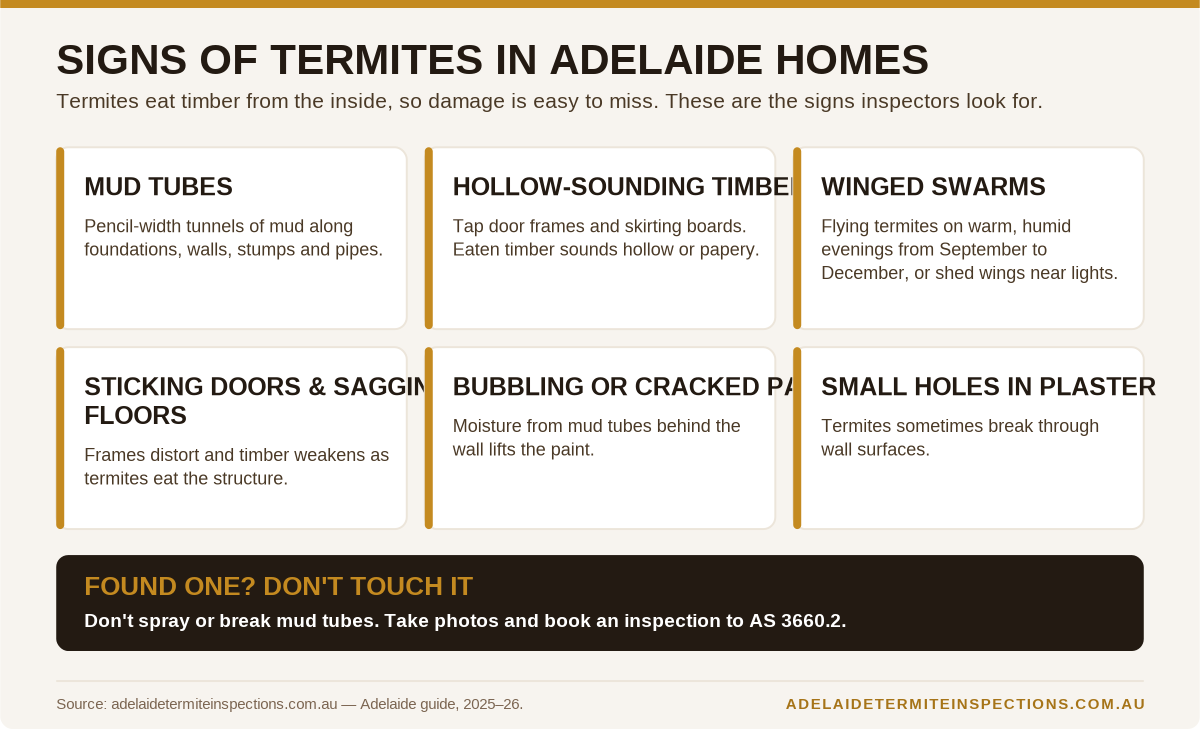
Subterranean termites build mud tubes (also called shelter tubes) to travel between their underground colony and the timber they're eating. These pencil-width tubes run along foundations, walls, stumps and pipes.
If you see mud tubes, termites are active or were recently active. Don't disturb the tubes — breaking them alerts the colony and makes it harder for an inspector to assess the extent of the infestation.
Why does termite-damaged timber sound hollow?
Timber eaten by termites sounds hollow or papery because they eat from the inside out, leaving only a thin shell. Tap door frames, window frames, skirting boards and other timber elements with a screwdriver handle to check.
When do termites swarm in Adelaide?
In Adelaide, swarming typically happens on warm, humid evenings between September and December. In spring and early summer, mature termite colonies release swarms of winged reproductive termites (alates).
If you see a swarm near your home — especially emerging from the ground, a wall or a tree stump — there is an established colony nearby. Discarded wings near windows or lights are another sign.
Other warning signs
- Sagging floors or ceilings — structural timber compromised from inside
- Doors and windows that stick — frames distorted by termite damage
- Bubbling or cracked paint — moisture from mud tubes behind walls
- Small holes in plasterboard — termites occasionally break through wall surfaces
- Frass (droppings) — small pellets near timber (more common with drywood termites, which are rare in Adelaide)
- Repeated power short circuits — termites are drawn to the warmth of electrical fittings behind walls
Which termites damage Adelaide homes?
Only a handful of termite species damage buildings. Australia has about 350 species, and roughly 30 are regarded as pests.
| Species | What to know |
|---|---|
| Coptotermes acinaciformis | The most widespread and destructive timber pest in Australia. Usually nests in trees, stumps, poles or buried timber rather than a mound. |
| Coptotermes frenchi | Common in urban areas of SA. Can eat out framing and leave only a thin veneer. |
| Nasutitermes exitiosus | Builds dome-shaped mounds 30–75 cm high near eucalypts and forages up to 50 metres from the nest. |
| Heterotermes ferox | Attacks damp and rotting timber such as fences and posts in contact with soil. |
What should you do if you find signs of termites?
- Don't disturb them. Don't spray, poke or break mud tubes. This scatters the colony and makes treatment harder.
- Book a professional inspection to AS 3660.2 as soon as possible.
- Take photos of what you found and note the location.
- Don't panic. Termite damage happens slowly over months and years, not days. A professional inspection followed by targeted treatment handles most cases.
Common questions
Can I check for termites myself?
You can look for visible signs (mud tubes, hollow timber, swarms) but a professional inspection uses moisture meters, thermal cameras and borescopes to find activity you can't see. Self-checking is not a substitute for an annual professional inspection.
How fast do termites cause damage?
A large Coptotermes colony can consume about 100 grams of timber per day. That's slow enough that annual inspections catch problems before they become structural, but fast enough to cause serious damage if left for several years.
Are flying ants and flying termites the same thing?
No. Termites are about the size of black ants but pale in colour, and CHOICE notes the winged ones (alates) are sometimes mistaken for moths. Discarded wings near windows or doors point to termites, because swarmers drop their wings once they have mated.
Will my council treat termites?
Not on private property. Adelaide Hills Council, for example, tells residents to contact a pest control company for termites on their own land, and to report nests found on council land so staff can inspect them.
Sources
- Adelaide Hills Council: Termites fact sheet
- CHOICE: How to recognise and manage termites
- Standards Australia: Australia's termite management standard revised
- SA Government: Managing the risk of termite damage to your building
Last reviewed .